Skip to main content


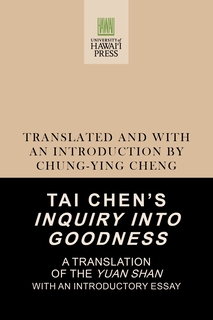
Tai Chen's Inquiry into Goodness
A Translation of the Yuan Shan, With an Introductory Essay
by Tai ChenChung-ying Cheng
From Sung times, and throughout the Ming period, one of the dominant philosophies of China had been a dualistic rationalism thought to be firmly grounded on the classics. Tai Chen (1723-1777) was a scholar and philosopher during the Ch'ing period- a time when China produced few philosophic thinkers. He was the greatest of these, and his views are embodied chiefly in Yuan Shan and in Meng Tzu txu-yi shu-cheng.
In place of the prevailing Sung dualism, Tai Chen propounded a rationalistic monism seldom before insinuated in a Chinese philosophy. He declines to accept current dogmas and preferred to seek his own truths. His commentaries opposed the time-honored interpretations of Chu Hsi, and he discredited them on purely philosophical grounds. But with few disciples to carry on his teachings, he was virtually forgotten or ignored in China for more than a hundred years after his death.
It was not until early in the present century- with China under the pressures of Western aggression and internal disorders-that Tai Chen's nearness to Western thought was rediscovered and his important role in the history of philosophy recognized. Curiously, this first of China's Western-oriented philosophers even today remains little known in the West and his major writings largely untranslated.
Recent Activity
Text Added Project Kickoff A Manifold project is born!
Texts
Uncategorized

Tai Chen’s Inquiry into Goodness
by Chung-ying Cheng- This text has 0 annotations
- This text has 0 highlights
Metadata
- restrictions

This work is licensed under a Creative Commons Attribution-NonCommercial-NoDerivatives 4.0 International License.
- edition1
- isbn9780824880835
- publisherUniversity of Hawai‘i Press
- publisher placeHonolulu
- rights© 1971 University of Hawai‘i Press
- rights holderUniversity of Hawai‘i Press
- rights territoryWorldwide
- series titleEast-West Center Press
Manifold uses cookies
We use cookies to analyze our traffic. Please decide if you are willing to accept cookies from our website. You can change this setting anytime in Privacy Settings.